

Management Debt: The Systems You Never Built Are Running Your Company
Growth isn’t what breaks most companies.
What breaks them is what they didn’t build while they were growing.
Management debt starts quietly. A promoted manager without clarity. A decision that gets escalated instead of owned. A system that gets deferred because things are still working.
Then one day, everything is slower. Decisions stall. Your best people are frustrated, and nobody can quite explain why.
That’s not growing pains. It’s accumulated debt coming due.
Your company is growing. Revenue is moving. Headcount is climbing. From the outside it looks like success.
From the inside, your best people are frustrated. Decisions are taking longer than they should and nobody can say exactly why. A question that should take thirty seconds to answer is still unresolved at the end of the day. Hiring is a permanent state of catchup. New hires take forever to ramp. Your managers are escalating things to you that you're fairly sure they should be handling themselves.
No single thing is catastrophically wrong. Everything is slightly more difficult than it used to be, and slightly more difficult than it should be, and it keeps getting worse.
That's not growing pains. That's management debt. And it started accumulating the day someone said we'll worry about that later.
The debt accumulates in the dark because you deferred building the lights.
What you deferred, and why it felt right
In the early stage, informality works. When the team is small enough that the founder can see everything, the founder is the operating system. They know who's performing and who isn't. They know what every decision requires. They can course-correct in real time because they're close enough to everything to see it.
You don't need a performance standard when you have twelve people and you can feel the pulse of the organisation from your desk. You don't need documented decision rights when the four people who make decisions are in the same room. You don't need a structured onboarding process when a new hire can sit next to someone for a week and learn everything they need to know.
Informality isn't dysfunction at that stage. It's efficiency. It's exactly the right way to operate.
The problem isn't the decision to stay informal. The problem is the moment that decision stops being right, which arrives earlier than almost anyone expects, and quietly, without announcing itself.
The recursive trap
Here's the thing about management debt that almost nobody explains clearly enough.
Fast-scaling organisations often lose visibility into organisational risk faster than they realise. Not because nobody cares, but because the systems required to detect the problem were never built in the first place.
No role clarity means no performance signal. No performance signal means no visibility into who's actually carrying the organisation. No visibility means reactive leadership. Reactive leadership concentrates dependency. Concentrated dependency overloads the people at the top. Overloaded leadership delays the system-building that would have broken the loop. And delayed system-building means more invisibility.
To know whether your attrition is a problem, you need to know who your high performers are. To know who your high performers are, you need a way to evaluate performance consistently. To evaluate performance consistently, you first need a clear definition of what success actually looks like in each role. And that definition is the first thing that gets skipped when the team is small and everyone seems to know what they're doing.
So the organisation that deferred role clarity hasn't just created an onboarding problem. It's made it structurally impossible to detect the signals that would tell it things are going wrong. It can't identify regrettable exits because it can't define regrettable. It can't define regrettable because it never defined exceptional.
This isn't an HR problem. It's a visibility problem. And visibility is what every operational decision depends on.
The compounding mechanism
Management debt compounds because unclear ownership creates more unclear ownership.
Here's the actual mechanism.
Unclear decision rights create escalations. Escalations train dependency. Dependency centralises authority. Centralised authority slows decisions. Slow decisions create workaround behaviour. Workaround behaviour destroys standardisation. Destroyed standardisation makes onboarding harder. Poor onboarding creates manager overhead. Manager overhead reduces strategic bandwidth. Reduced strategic bandwidth delays the system-building that would have broken the loop.
One missing system. Cascading failures across five downstream processes. Multiplied across every function. At the speed of hypergrowth.
It shows up like this in practice.
Nobody's written the approval policy. A manager who needs to spend six thousand dollars on something genuinely urgent asks their director. The director isn't sure either, so they ask their VP. The VP is in back-to-back meetings and doesn't respond until tomorrow. By the time the answer arrives the moment has passed. Multiply that across every manager in the organisation, every week, and you begin to understand what founders mean when they say everything feels slower than it used to.
New hires arrive. Nobody's written the role definition precisely enough to screen effectively, so hiring managers spend their time interviewing candidates who were never right for the function. The hire who does get through arrives to find a company that's already changed shape around them. They're unclear on what they own within weeks. Not because they're the wrong person. Because the system that would have told them was never built.
None of this feels like a crisis. The company is still growing. Revenue is still moving.
At 40 people this creates friction. At 400 people it becomes governance failure.
What it feels like from the inside
You won't wake up one morning and think: we have a management debt problem.
If you're reading this and thinking this doesn't quite sound like us, we're more on top of it than this, that response is worth paying attention to. Not because it means you're wrong. Because it's the same response most founders have before the signals become undeniable.
Here's what management debt actually feels like before anyone's named it.
Work that used to flow has become a slog. Decisions that should take minutes are taking days. Your calendar is full of meetings that exist to resolve things that should have resolved themselves. Your best people seem frustrated but can't quite name why. Hiring is always behind, always overwhelming, always a game of catchup you never quite win.
A question that should take thirty seconds to answer is still unresolved at the end of the day. Not because nobody cares. Because nobody knows who has the authority to answer it. So it goes to five people, each of whom redirects it to someone else, and by the time it resolves the person who asked has either improvised a solution or quietly given up.
That's not a communication problem. That's a missing system revealing itself.
Two questions worth sitting with honestly. How long does it take a new hire in your organisation to reach full effectiveness? If three people gave you three different answers, that gap is the debt making itself visible. How many decisions required your personal involvement last week that should have resolved below you? The answer is probably higher than it was six months ago. That trajectory is the signal.
When founders finally name it
Most founders name this problem when revenue has missed projections for three consecutive quarters.
That's far too late.
By the time the execution failure makes the problem impossible to ignore, the debt has been compounding for a year or more. The exits have been telling you for months. The hiring manager who can't describe what good looks like in the role they're trying to fill has been telling you. The manager who keeps escalating everything upward has been telling you. The leadership team whose calendar is full of decisions that should never have reached them has been telling you.
These signals read like operational friction. Inconvenient, worth addressing eventually, not mission-critical right now. They're not friction. They're early data on a structural failure that will eventually show up in your delivery dates, your retention, and your revenue line.
The people most likely to leave are often the ones most capable of recognising that the systems aren't keeping pace with the ambition. They have options. They read the signals. And unlike the organisation, they've got the clarity to act on what they're seeing.
What remains, without a structured way to evaluate it, is a workforce that looks intact from the outside and is quietly hollowing from within.
The point where founders push back
This is where founders sometimes think: this sounds like someone making the case for more process.
It's worth sitting with that objection for a moment.
The argument here isn't that you need more process. It's that without specific operational infrastructure, you can't see your own risk. You can't measure who your high performers are, so you can't retain them deliberately. You can't define what effective looks like in each role, so you can't evaluate performance accurately or onboard effectively. You can't clarify decision rights, so your management layer defaults to escalation and your calendar fills with decisions that should never have reached you.
And when you lose a senior leader you were relying on, the cost isn't just replacement. It's the stalled decisions, the lost context, the team instability, the months of organisational drag that follow while everyone else absorbs the gap. For a company of 150 people losing three senior leaders in a year, that's a significant and entirely foreseeable cost that appears nowhere in the budget because nobody was tracking the conditions that made it inevitable.
The most common plan is to hire a strong people leader once things feel out of control and let them sort it out. That plan has two problems. The first is that if you're doubling headcount year over year, waiting until things feel out of control is already late. The second is that the leader you hire will spend their first year doing nothing but reactive hiring and damage control because the structural debt that accumulated before they arrived will consume all of their bandwidth. You won't get the strategic function you needed. You'll get an expensive firefighter.
Three specific foundations make everything else possible. Role definitions precise enough to measure against. Decision rights clear enough that authority doesn't need to be negotiated in real time. A performance framework rigorous enough to surface signal rather than just generate activity.
Without them you're not staying lean. You're flying blind at increasing speed.
The window
Addressing management debt early is fundamentally different from addressing it after the organisation has already scaled around the absence of structure.
Early intervention means building systems into a team still small enough to absorb them without major disruption. Managers promoted without clarity can be given clarity before the absence of it calcifies into habits that are hard to change. Decision rights can be established before the organisation has learned to route everything upward.
Late intervention means rebuilding systems while the organisation is running at full speed, carrying the habits and workarounds that filled the vacuum left by the systems that were never built. That's harder, slower, and more expensive. Not impossible. But categorically different from what it would have been earlier.
The longer you wait, the more organisational behaviour calcifies around the missing structure. In a hypergrowth environment, that entrenchment happens fast.
Scaling doesn't create organisational fragility. It reveals how much of your company was operating on intuition the entire time.
The missed quota. The slow decision. The exit you didn't see coming. The calendar that stopped being yours. Each of those is a data point from a measurement system your organisation was never designed to read.
You Know What Your People Cost. Do You Know What They're Worth?
You know your burn rate to the dollar. You know your CAC, your LTV, your gross margin. You can tell me what you spent on AWS last month and whether it was worth it. You can pull your ad spend attribution in twenty minutes and tell me which campaigns generated pipeline.
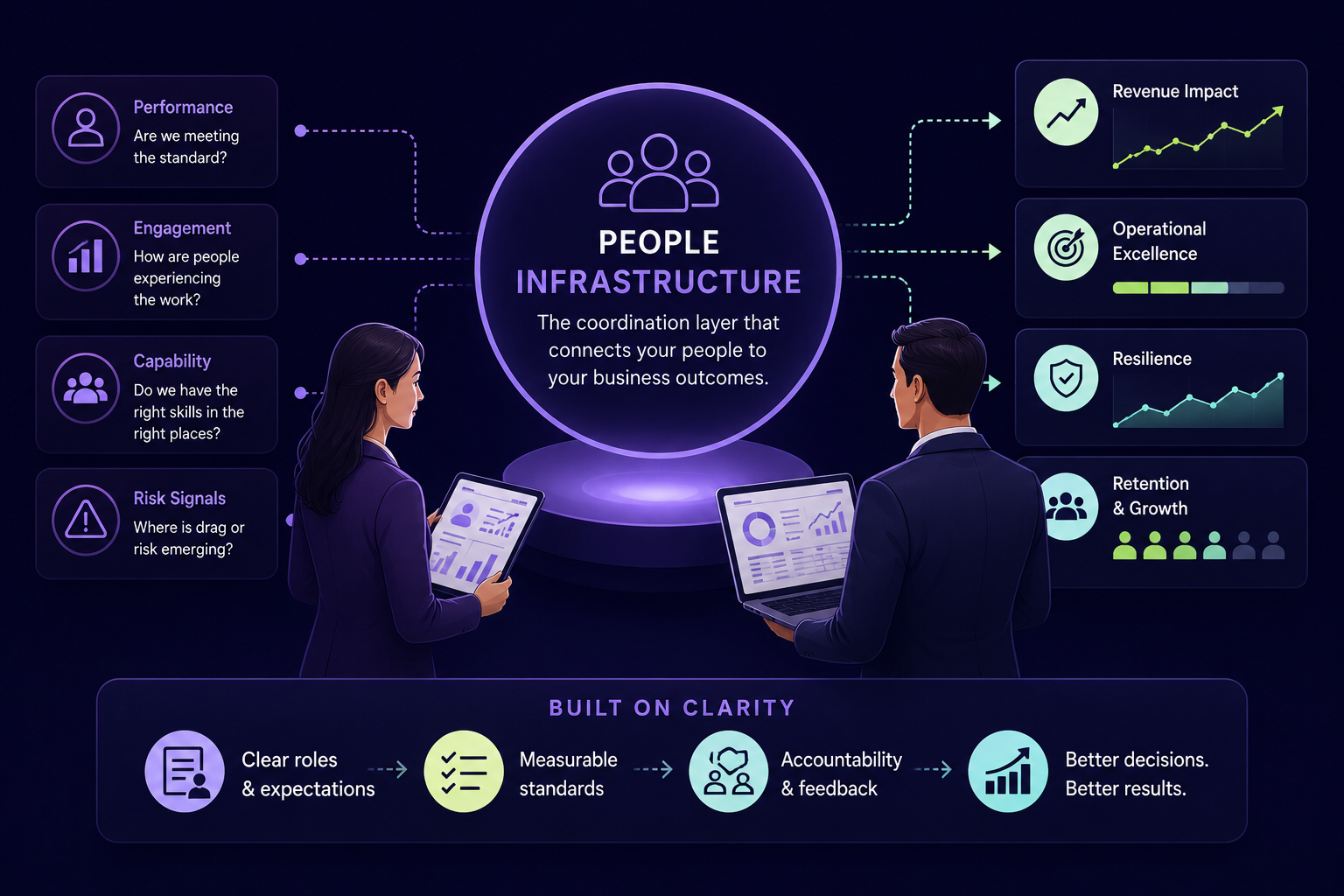
Your people investment is larger than all of those combined. And every other compounding asset in your business, your codebase, your brand, your distribution, your institutional knowledge, depends on people systems capable of building, maintaining, and scaling it. People aren't just another compounding asset. They're the coordination layer that determines whether every other asset compounds at all. The right people in the right roles don't just deliver their output this quarter. They build capability, catch problems early, raise the performance of everyone around them, and generate returns that grow over time. People in poorly defined roles with no performance standard don't just underdeliver. They make decisions that cost more than they deliver, create drag the org absorbs without knowing it, and push good people toward the exit.
You know what your people cost. You have almost no idea what they're generating, how that value compounds, or where you're losing it.
That's not a people problem. That's a measurement problem.
For decades organisations have operated on tacit organisational intelligence. Undocumented knowledge about performance, capability, dependency, and operational risk that lived mostly inside managers' heads. The data always existed. The economics of maintaining it at scale did not. AI changes that. Not by replacing the judgment required to act on it. By making the underlying intelligence architecture finally practical to build and sustain.
And it just became solvable. For the organisations willing to build it. And for the HR practitioners who have been waiting for this moment whether they knew it or not.
People infrastructure is the operational system through which an organisation defines, measures, maintains, and scales its human performance standards, organisational resilience, institutional knowledge, and execution capability. Not a department. Not a set of programs. An operating layer. The connective tissue between your people and your business outcomes.
Here's what managing people as a flat cost actually looks like in practice.
The rep who was eighteen months in and still couldn't close enterprise deals, not because they lacked effort but because nobody ever defined what enterprise-ready performance actually looked like in that role, so nobody caught it until the pipeline was already damaged.
The product launch that slipped six weeks because two senior engineers were underperforming and their manager had no framework to have the conversation early enough to matter.
The enterprise deal that walked after eight months of sales cycle because the customer success hire couldn't operate at that complexity level, a fact that would have been visible in the first ninety days to anyone with a rigorous onboarding standard.
The churn rate that got blamed on the product roadmap for two quarters before anyone looked upstream and found a customer success team with no defined performance standard and no accountability structure underneath it.
Every one of those is a revenue number. Every one of them is also a manifestation of hidden organisational fragility. The vulnerability that lives in undefined roles, unmeasured performance, and signals nobody was reading. Most organisations never connect it back to the people decision that caused it. So they fix the symptom, miss the cause, and wonder why the same problems keep recurring at higher stakes.
Done properly, people infrastructure doesn't just reduce those losses. It actively drives revenue. The right people in clearly defined roles with rigorous performance standards and real accountability don't just execute your strategy. They improve it. They surface problems earlier. Every people decision compounds. The only question is whether it's working for you or against you.
Do it right and you'll see it in the numbers.
HR has the data to build this picture. It always has. It sits at the intersection of every function, every team, every revenue outcome. It surfaces flight risk signals before the resignation letter. It surfaces performance drag signals before the missed quota. It reads the organisational signals that will blow up a product launch three months before the launch. No other function has that vantage point.
I've spent fifteen years in that vantage point. The urgency was always real. The frustration was always real. I've built operational heat maps, connected people data to business outcomes, seen exactly where the gaps were. But keeping role definitions accurate to what a role actually demands, in real time, while the org is scaling and the work is changing underneath you? Without AI assistance that's impractical at best. A full time job nobody has budget for. So the data existed. The insight existed. The ability to keep it current, scalable, and connected to business outcomes without significant headcount cost attached? That's new.
The tools to do that translation exist. The methodology to build it is no longer theoretical. And if you needed a reason to care about this right now rather than later, here it is.
AI spend is now a real operational cost on your P&L. Every organisation integrating AI tools is spending on compute, and that spend is scaling fast. The shift from subscription to token-based pricing means efficiency matters. You need to know whether your AI investment is generating returns.
You cannot measure that without people infrastructure underneath it. Here's the dependency chain. To know whether AI-assisted output is good, you need a defined standard for what good looks like in that role. To know whether someone is prompting efficiently, you need a benchmark for what competent AI direction looks like for that specific task type. To know whether your compute spend is generating returns, you need all of that mapped before you run a single query.
A RevOps analyst producing a forecast with AI costs tokens. Whether those tokens produced a forecast worth acting on depends entirely on whether you defined what a good forecast looks like before the prompt was written. Most organisations haven't. Which means they're spending on AI with no way to know if they're getting value.
Prompt quality is an emerging performance dimension. Token efficiency is an emerging cost metric. Neither is measurable without the people infrastructure underneath them. That's not an AI problem. That's a people infrastructure problem.
Here's what that looks like in practice. A customer success manager's output variance signals start declining relative to their role definition. Peer reliance signals rise as colleagues begin routing questions through them that should be handled independently. Engagement drift signals emerge in how they describe their workload. Historically those signals lived in separate systems, reviewed separately, by different people, on different timelines. Connected together through a people infrastructure model, they surface elevated operational risk around institutional knowledge concentration and potential flight risk months before attrition occurs. The business outcome is a retention conversation that happens in time to matter rather than an exit interview that happens after the damage is done.
That's not a prediction algorithm. That's organisational visibility. The signals were always there. The infrastructure to connect them in time to act wasn't.
The gap between what HR always knew it could be and what it actually delivered wasn't a knowledge problem. It wasn't a capability problem. It was an infrastructure and economics problem. AI dramatically compressed it. The data connections that used to require a team of analysts and months of work are now executable in weeks with AI assistance. The synthesis that lived in one CHRO's head can now be systematised. The links between people decisions and revenue outcomes that were always theoretically traceable can now actually be traced, maintained, and reported in language that lands in a CFO conversation.
To founders and CEOs reading this: you have been underutilising the most strategically important function in your business. Not because your HR team isn't capable. Because you hired them to do compliance and called it people strategy. The function that determines whether your go-to-market executes, whether your product gets built, whether your customers stay, has been filing paperwork and running engagement surveys while your revenue strategy hoped for the best.
And you felt it every time one of those examples above happened in your org. You just didn't know where to look.
There is a more rigorous way to build this. Role definitions that map directly to performance standards. Task taxonomies that make output quality measurable. People data connected to revenue outcomes with the same analytical discipline you'd apply to any other operational investment. It exists. It's buildable. Most organisations just haven't been told it's an option.
That's on leadership. Not HR.
To HR practitioners reading this: the tools finally caught up to what we always knew was possible. That's not a celebration. It's a reckoning.
The profession has been underperforming its own potential for decades. Not because the people in it aren't capable. Because the operating model was built around compliance and administration and most of us never fully broke from that origin story. We ran engagement surveys because we were supposed to. We did performance reviews because it was that time of year. We called it people strategy when it was really people administration.
The constraint was never capability. It was economics. We couldn't maintain the intelligence architecture the function always needed at a cost organisations could justify. That's changed.
Which means the excuse is gone. The practitioners who understand that will finally build what the function was always supposed to be. The ones who don't will find it being rebuilt around them by people who understood what was at stake when the moment arrived.
The profession is at an inflection point. The organisations that build rigorous people infrastructure now, that connect role clarity to performance measurement to revenue outcomes, that treat human capital with the same analytical rigour applied to any other operational investment, those organisations will outperform the ones that don't. Measurably. Visibly. Inevitably.
HR either leads that build or watches someone else do it. A consultant. A RevOps leader who got tired of waiting. A founder who figured out that people infrastructure is actually a revenue problem and started treating it like one.
The old ways aren't going to be good enough anymore. Compliance checkbox HR doesn't survive the next five years. Not because it gets eliminated. Because it becomes irrelevant while the business gets built around it by people who understood what was at stake.
That fight is over. Not because we won the argument. Because the argument became economically unavoidable.
The function that determines whether every other function executes now has the tools to prove it. AI just made that provable.
The organisations that understand this first will build compounding advantages that become increasingly difficult to close. Not because they adopted AI faster. Because they finally learned how to see their own organisation clearly.
That's what people infrastructure actually is. Not a better HR function. A clearer view of how your organisation actually works, where it's strong, where it's fragile, and what it will take to build something that compounds in the right direction.
The data connections are there. The methodology is emerging and the economics finally support building it. The only question is whether you build it before the gap between you and the organisations that already have becomes impossible to close.
You Can't Manage What You Can't See. Here's What to Build First.
Most founders assume that because people systems are interconnected, it doesn't much matter where you start. Build the performance framework. Map the succession plan. Clarify the decision rights. The order feels arbitrary because the problems feel simultaneous.
That assumption is how you end up with a performance framework nobody can use, a succession plan that doesn't reflect how the organisation actually works, and decision rights that exist on paper and nowhere else.
The interconnectedness isn't a reason to start anywhere. It's exactly why sequence matters.
Think about construction. Nobody argues that because a building's electrical, plumbing, and structural systems are all interconnected, you can install them in any order. The sequence is determined by dependency. You frame before you wire because the wire has to go somewhere. You pour the foundation before you frame because the frame has to stand on something. The interconnectedness is the argument for sequence, not against it.
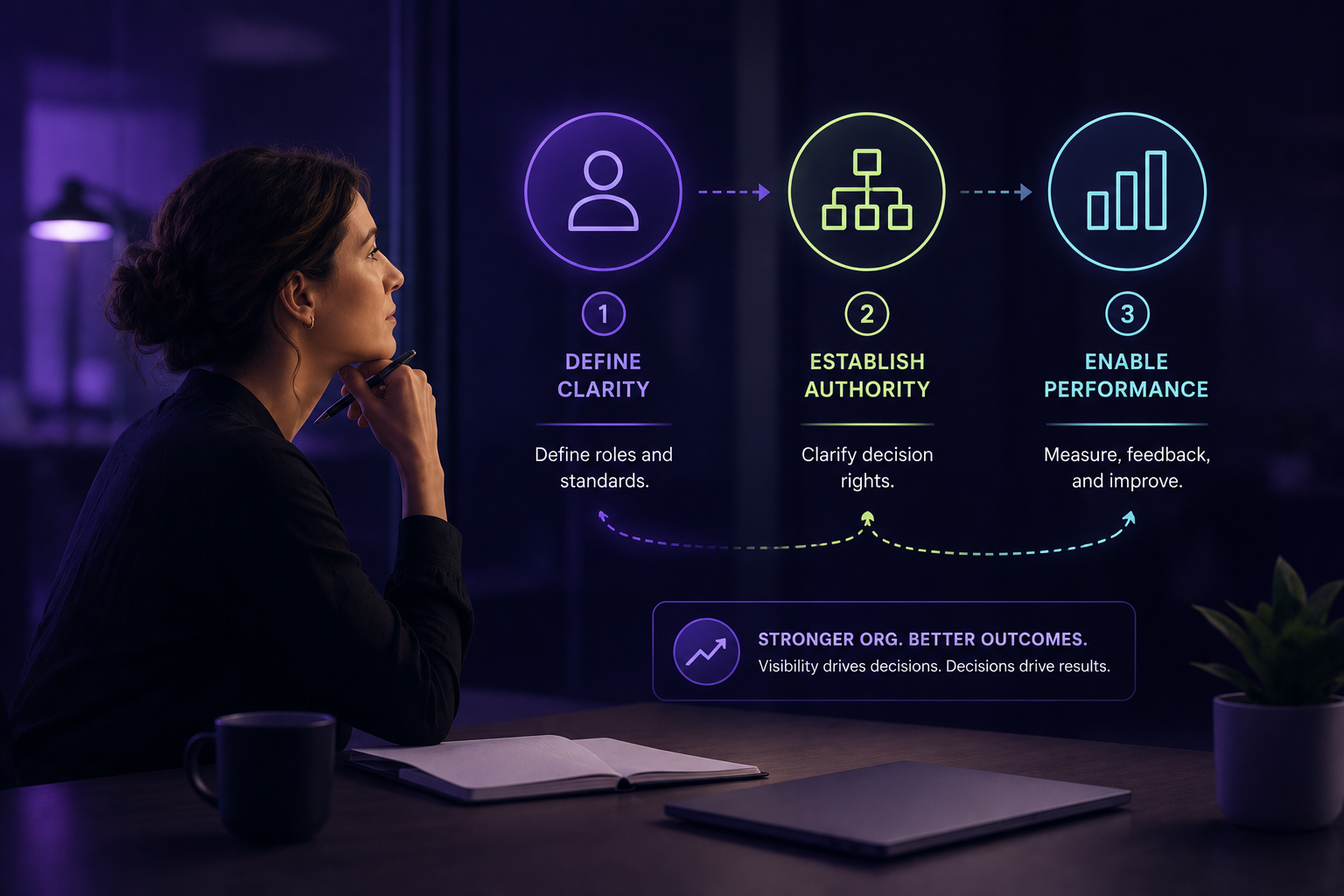
People infrastructure works the same way. Three foundations. One sequence. Each one makes the next possible. Attempt them out of order and you get the partial interventions most scaling organisations default to: visible in the data but not actionable, accountable in theory but not in practice.
This isn't an HR function problem. It's an operating system problem. The people systems underneath your organisation determine whether decisions flow, whether performance is legible, and whether the people you're counting on can actually do what you hired them to do. That's not a soft capability. It's the infrastructure your execution depends on.
Worth naming one thing clearly before going further. In early-stage companies, ambiguity is often intentional. Loose role boundaries preserve adaptability. Informal decision-making moves fast. That's not dysfunction, it's appropriate for the stage. The problem isn't ambiguity itself. It's that ambiguity becomes increasingly expensive past a certain scale threshold, and most organisations don't notice the transition until the cost is already compounding. Most can survive without formal people infrastructure longer than they think, usually until headcount, managerial layering, or cross-functional dependency reaches the point where informal coordination stops scaling. By then the debt is already significant.
The model underneath everything that follows is straightforward. Organisational performance depends on three things working together: a clear definition of what good looks like in each role, a clear map of who has authority to act on it, and a feedback system precise enough to surface when reality is drifting from the definition. Each depends on the one before it. None of them work alone. And most scaling organisations are missing at least one, usually the first.
Before you build anything, one diagnostic question worth sitting with honestly. If hiring feels inconsistent, you're likely missing role definitions. If decisions keep stalling or landing on the wrong desk, you're missing decision rights. If performance conversations feel subjective and nobody quite knows what they're evaluating, your performance framework isn't operating as a system. The answer tells you where to start. The sequence tells you what comes next.
Here's why neither is arbitrary.
Foundation one: Role definitions
Not job descriptions. Role definitions. Most organisations treat these as interchangeable. They're not, and the confusion is one of the most expensive mistakes in people operations.
You can build a job description from a role definition. You cannot build a role definition from a job description. That's not a semantic distinction. It's a functional one.
A job description is a recruiting artifact. It describes the candidate profile, the surface-level responsibilities, the qualifications required, and the reporting structure. It's designed to attract and screen. It's optimised for the moment of hire, and it becomes largely administrative once that moment has passed. Useful for recruitment, for functional role assessments, for workers' compensation or disability purposes. A point-in-time snapshot that serves specific purposes and was never designed to carry more weight than that.
A role definition is not a single document so much as a defined system of expectations that answers a different and more demanding question: what does good performance actually look like in this role, and how would you know if it's happening?
Not at hire. At every stage of the employee lifecycle.
What does good look like at thirty days, when someone is still orienting to the environment? At sixty, when they should be operating independently in the core functions? At ninety, when they should be contributing without hand-holding? At six months, when the basics should be fluent? At a year, when they should be building capability in others or driving improvement in their domain?
A role definition holds those benchmarks and connects them into a coherent arc. It describes what someone is accountable for producing, what decisions they own, what they depend on from adjacent functions to operate effectively, and what the indicators of success look like at each stage of tenure. It's a living document, updated as the work evolves, as the organisation scales, as the role itself changes shape under the person holding it.
The job description is static by design. The role definition is longitudinal by design. Both serve legitimate purposes. They are not the same document and they are not substitutes for each other.
This is also distinct from job architecture or leveling frameworks, which operate across roles to establish hierarchy, comparability, and compensation bands. Role definitions operate inside a specific role, at the level of performance clarity and lifecycle expectations. Both matter. They are not the same layer.
Most organisations figure this out the hard way.
A performance issue surfaces. The manager pulls the job description and discovers it tells them almost nothing useful. The person is responsible for "managing key accounts" or "supporting the engineering team" or "leading the customer success function." None of that is precise enough to anchor a performance conversation, let alone a performance improvement plan.
So the manager improvises. And here's where it gets worse than vague.
In the absence of a defined standard, every person in the performance conversation is working from a different implicit one. The manager thinks they're managing to the standard they've observed informally. The employee thinks they're being evaluated against what they were told at hire. HR is working from the job description. The skip level has a fourth version based on what they've seen in practice. Nobody has articulated any of those standards explicitly because everyone assumed the others shared their understanding.
That's not a performance conversation. That's a multi-party negotiation about what the standard should have been, happening after the fact, with real consequences attached to the outcome.
The business cost of skipping role definitions runs deeper than most organisations ever trace.
Without a role definition precise enough to screen against, recruiters present candidates against the job description, which describes a person, not a performance standard. The hiring manager interviews without a clear picture of what good looks like at thirty, sixty, ninety days. They hire on instinct and interview performance, both of which are unreliable predictors of role-specific success at scale. The new hire arrives without a shared understanding of what success looks like, because that understanding doesn't exist in any documented form. The gap between their interpretation and the organisation's accumulates invisibly. Eventually it becomes undeniable. The organisation concludes the person was wrong for the role.
Maybe they were. Or maybe they were exactly right for a role nobody ever properly defined.
The replacement cost lands. The organisation posts the role again, against the same job description, and the cycle starts over. Because nobody fixed what was actually wrong.
The same mechanism runs through every function. The sales rep who's eighteen months in and still not closing enterprise deals. The manager concludes it's a performance problem. Maybe it is. But maybe nobody ever defined what enterprise-ready performance looks like in that role at eighteen months. Maybe the rep is doing exactly what they understood the job to be. Maybe the coaching conversations have been vague because the manager doesn't have a precise standard to coach against either.
So the organisation manages the rep out. Pipeline damaged. Cycle restarted. The next hire walks into the same undefined role.
The question the organisation never asks is the one that would break the loop. Not why did this person fail. But what were they failing against. Because if you can't answer that precisely, you don't actually know whether the person failed or the definition did.
That's why role definitions come first. Every other foundation depends on them.
Foundation two: Decision rights
Role clarity tells someone what they're accountable for. Decision rights tell them what they're authorised to do about it.
Without the second, the first creates clarity without agency. People know what they own but not what they can move. So they do what any reasonable person does in an ambiguous situation: they ask. They escalate. They wait for confirmation that never comes cleanly because nobody's built the system that would provide it.
Decision rights aren't an org chart. An org chart tells you who reports to whom. Decision rights tell you who can approve what, at what threshold, without needing to involve anyone above them. They're the operating system that converts role accountability into actual authority.
The absence of decision rights produces two failure modes. One is visible and acute. A critical vendor contract sits unsigned because nobody is certain who has authority to approve it at that value. The deal the business needed closed last Tuesday. The other is chronic and harder to see, which makes it more expensive. Every decision that resolves at the wrong level costs the time of everyone above it in the chain. The manager who could have moved something in twenty minutes instead writes an email. The director who could have approved it in ten minutes puts it on the agenda for a meeting four days away. The VP makes the call in thirty seconds and wonders why it took two weeks to get there.
Multiply that across every function, every week. Delivery dates slip in ways that are genuinely hard to explain. It's rarely a capacity problem. It's a decision velocity problem. The work isn't blocked by lack of people or effort. It's blocked by authority that isn't clearly enough defined to move without escalation.
But the deeper dysfunction isn't speed. It's accountability isolation. When decision rights are undefined, accountability and authority drift apart. Managers become coordination nodes rather than decision owners. Executives become error-correction layers rather than strategic leaders. The org chart shows who reports to whom. It says nothing about who actually owns which outcomes. And when something goes wrong, as it always eventually does, nobody can cleanly say whose call it was. Because structurally, it wasn't anyone's. It was everyone's, which means it was no one's.
What breaks when you skip decision rights and go straight to a performance framework: you build a system that can identify who's underperforming but can't distinguish between a performance problem and an authority problem. The manager who's escalating everything upward isn't necessarily weak. They may simply be operating in an environment that never told them what they were allowed to decide. Managing them out solves nothing. The next person in that role escalates everything too. Because the system still doesn't have decision rights.
Decision rights come second because they depend on role definitions to function. You can't clarify what someone is authorised to decide without first knowing what they're accountable for. Define the accountability first. Then define the authority that goes with it.
When both exist together, decisions start resolving at the level where the information lives. The leadership calendar begins to reflect actual decision-making architecture rather than the accumulated weight of everything that couldn't resolve below it.
Decision rights also require active maintenance. Ambiguity re-enters the system at every inflection point: rapid hiring, reorgs, product pivots, leadership changes. Define them clearly, then expect to revisit them.
That's not a culture shift. That's a systems outcome.
Foundation three: A performance framework rigorous enough to surface signal
The first two foundations define what good looks like and who owns what. The third makes that picture legible over time.
Most performance frameworks aren't broken because nobody uses them. They're broken because they were built to manage compliance rather than enable performance. Compliance frameworks serve a legitimate purpose. Organisations need auditability. They need minimum governance standardisation. A compliance framework delivers that. The problem isn't that they exist. It's that most organisations deploy them as performance management tools when they were designed as audit tools. And here's the thing about using an audit tool as a performance tool that most organisations never reckon with honestly: it doesn't even do the compliance job properly.
Here's what a compliance framework actually produces. HR spends weeks chasing managers about overdue reviews. Managers yeah-yeah their way through minimum effort to get HR off their backs. Checkboxes get ticked. Documents get filed. Nobody's performance improves. Nobody's particularly happy about the process. And the organisation tells itself it has a performance management system.
It doesn't. It has a documentation system that generates the appearance of performance management while the actual performance questions go entirely unaddressed.
And when a termination gets challenged, the question isn't whether reviews were completed. It's whether the reviews reflected genuine performance management or administrative activity. A stack of yeah-yeah checkbox reviews doesn't demonstrate that the organisation managed performance. It demonstrates that the organisation went through the motions. That's not legal protection. That's evidence of a system that was never doing what it claimed to do.
Do it right or don't do it at all.
A properly built performance framework does something categorically different. It doesn't manage performance. It enables it. At minimum, it translates role definitions into observable, time-bound indicators of contribution across 30, 60, and 90 day cycles and beyond, maintained against the current role definition rather than the one that existed at hire.
Managing performance is reactive. Something drifts, the system documents it, someone has a conversation. The framework exists to create a paper trail.
Enabling performance is proactive. The framework creates clarity before anything goes wrong. The employee knows what they're building toward at every stage of their lifecycle in the role. The manager knows what they're developing, not evaluating. The organisation knows whether its people are compounding or losing ground, early enough to do something about it.
That clarity benefits everyone, not just the organisation measuring the outcomes.
Uncertainty is cognitively expensive. An employee who doesn't know if they're performing, who can't clearly articulate what good looks like in their role, who isn't sure what they need to do to grow, is carrying ambient anxiety that consumes mental bandwidth that should be going toward the work. Not dramatically. But constantly, in the background, every time they make a decision or interpret a piece of feedback or wonder what their manager actually thinks.
Remove that uncertainty and you free up that capacity. Not because the employee is trying harder. Because the system isn't taxing them with questions it should have already answered. That cognitive overhead, redirected toward the work, compounds across every person in the organisation. One employee with role clarity is a marginal gain. A hundred employees who all know what they're building toward, what decisions they own, and where they stand against a clear standard, is a structural productivity advantage that doesn't show up as a line item but absolutely shows up in output.
Win for the employee, who gets to spend their energy performing rather than worrying about whether they are. Win for the organisation, which gets the productive version of its people rather than the anxious one.
Managers resist performance conversations when they feel like prosecution. They engage with them when they feel like coaching. The role definition is what makes that shift possible. It gives the manager something specific and constructive to develop the employee toward, not something vague to evaluate them against. The conversation changes because the purpose changes.
The performance framework is the third foundation because it's the one that makes the first two legible and actionable over time. Role definitions tell you what good looks like. Decision rights tell you who has authority to act. The performance framework tells you whether what's happening matches what you defined, surfaces the gap early enough to address it, and creates the documentation that makes every subsequent people decision defensible, because it reflects genuine management rather than performed administration.
When all three exist and are properly sequenced, something else becomes possible that wasn't before. You can actually see your organisation.
Not the org chart version. The operational version. Who is performing above what the role requires. Who is struggling below it and at what stage. Where decision-making is flowing cleanly and where it's backing up. Which roles are carrying more than they were designed to carry. Which managers are building capability in their teams and which are accumulating dependency.
That's organisational visibility. And it's what makes operational decisions consistently reliable at scale.
Why AI changes the economics but not the sequence
The reason these three foundations weren't universally built before isn't that nobody knew they were important. It's that maintaining them at scale required continuous analytical overhead most organisations couldn't sustain. Keeping role definitions current as the work evolved. Updating decision rights as the organisation changed shape. Running performance frameworks that stayed connected to the underlying role definitions rather than drifting into generic templates that measured nothing specific.
AI changes that calculation. Not by replacing the judgment required to define what good looks like in a role, and not by solving for definition quality or enforcement discipline, both of which remain human work. But by reducing the maintenance burden of keeping the picture current as the work changes underneath it. Role definitions that update as the role evolves without a months-long project. Performance signals that surface against the current definition rather than the one that existed at hire. Decision rights that can be recalibrated as the organisation scales without requiring a full governance review.
To be precise about the boundary: AI can update documentation, not define standards. It can surface drift, not resolve ambiguity. It can maintain systems, not design them. The judgment layer remains human. What changes is the cost of keeping the infrastructure current enough to be useful.
The sequence doesn't change. The cost of maintaining it does.
Which means the organisations that build this infrastructure now aren't just managing their people more effectively. They're building an operational advantage that compounds. The visibility they develop into their own organisation becomes increasingly difficult for competitors without that infrastructure to replicate.
Not because they adopted AI faster. Because they finally built the foundation that makes organisational intelligence possible in the first place.
Most organisations skip role definitions because they already have job descriptions and assume that's close enough. It isn't. Most skip decision rights because clarifying authority feels like a political conversation nobody wants to have. It's not political. It's operational. Most build performance frameworks oriented toward compliance and wonder why nothing actually improves. Nothing does because that's not what those systems were built to do.
The sequence isn't complicated. But it requires starting at the beginning rather than at the part that feels most urgent.
Role definitions first. Decision rights second. A performance framework built to enable rather than administer third.
In that order. For reasons that aren't arbitrary.
When you get it right, something changes that you can feel before you can measure it. People stop spending energy on uncertainty. Managers stop avoiding conversations. Decisions start resolving at the level where the information lives. The organisation gets the productive version of its people because it finally gave them what they needed to actually perform.
That's not an HR outcome. That's a business one.
Your Org Chart Tells You What You Have. It Doesn't Tell You Whether It'll Hold.
A while back I was watching my partner build a PC. He works in high performance computing, has patents in air cooling design, and he approaches a build with the precision of someone who knows exactly what happens when one component fails at the wrong moment. Anti-static lab coat. Zero shortcuts. He was explaining his decisions out loud as he went.
I was half listening. The other half of my attention was on a company I'd been working with that had just lost a key person at the worst possible moment.
He was installing redundant drives. You don't build a high performance system assuming everything will work perfectly. You design for failure because you know it's coming.
I was thinking about the account manager who had just resigned. Three years of client relationship knowledge. Gone in two weeks notice. No backup. Six months to recover. Two clients lost.
Something clicked.
The organisation is a system. People are the interconnected nodes that allow it to function. So what happens when they fail?
Most companies have no idea. Not because they haven't thought about it. Because they've never built the infrastructure to see it clearly.
Your org chart is not a resilience plan
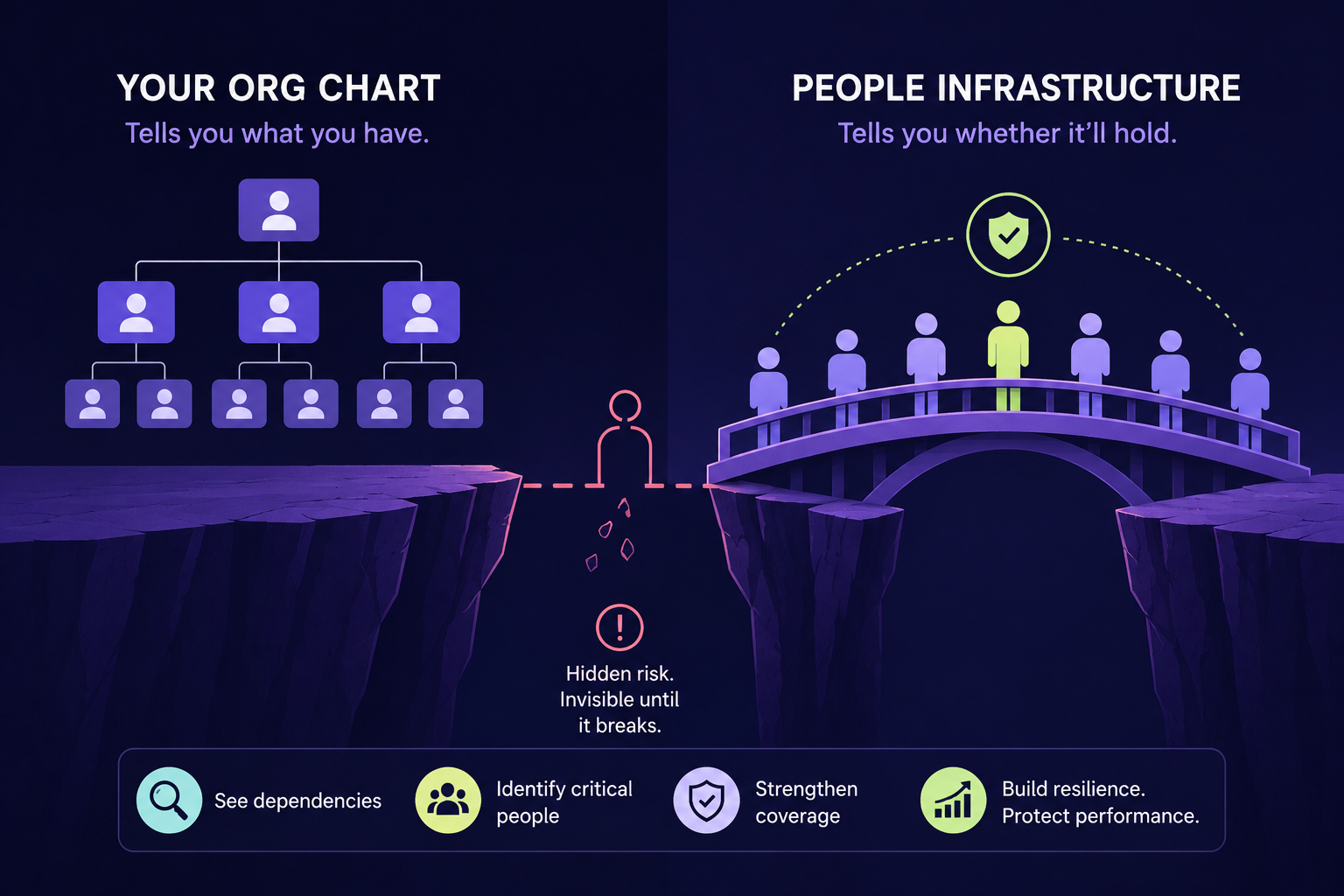
Most businesses believe they're managing resilience because they have an org chart and a headcount budget. They're not. Headcount management is ensuring the system has enough components to run. It says nothing about what happens when a critical component goes down.
Real resilience planning asks different questions. What happens if this person isn't here tomorrow? Who absorbs the work? Where does the institutional knowledge live? What breaks immediately versus what degrades slowly over the following weeks? What's the realistic recovery timeline?
Run that test on your five most critical roles right now. Not the most senior. The most operationally dependent. If you can't answer those questions cleanly and quickly, you don't have resilience planning. You have a headcount count and a hope.
Worth naming one thing clearly before going further. In early-stage companies, dependency concentration is often intentional and appropriate. A small team naturally concentrates knowledge and authority in a small number of people. That's efficient at first. The problem begins when dependency concentration scales faster than organisational visibility. When the business grows around the concentration rather than designing through it, what was once agility becomes fragility. And the transition is almost always invisible until something breaks.
Traditional succession planning doesn't solve this. It covers the C-suite. It targets identified high potentials. It doesn't systematically map operational dependency regardless of seniority, which is the question that actually matters. The data to answer that question has always existed. What most companies lacked was a practical way to surface it continuously.
What makes a role genuinely load-bearing
Not every critical role looks critical on paper.
A role becomes load-bearing when its failure creates disruption beyond its own boundaries. Work slows elsewhere. Decisions bottleneck. Recovery takes longer than expected because the knowledge concentrated in that role was never designed to be shared. Decision authority accumulates around the person holding it because they've become the default resolver for problems that should route through multiple paths.
The clearest structural signal is asymmetric peer reliance. More people depend on them than they depend on anyone else. That dependency doesn't appear on the org chart because it lives in informal patterns rather than reporting lines. It's the thing that's hardest to see and the thing that matters most.
Every unexpected departure carries replacement cost. But the bigger loss is hidden: slowed execution, delayed decisions, customer disruption, and leadership time redirected into recovery. For a role that was genuinely load-bearing, that cost compounds across every function that depended on it.
This is what people infrastructure is actually designed to surface: hidden organisational fragility. The vulnerability that doesn't appear on any org chart, any headcount plan, or any succession document. The risk that lives in informal dependencies, undocumented knowledge, and invisible load bearers. It accumulates silently.
It reveals itself suddenly.
The costliest person to lose probably isn't in a key role
The most dangerous manifestation of hidden fragility isn't the empty org chart box. It's the person who isn't in a designated key role but is actually holding the ceiling up.
Every company has them. The one everyone goes to. The one who knows where everything is, how the work really gets done, and why the documented process bears little resemblance to operational reality. The one whose workload, if you looked at it properly, is running at two hundred percent of what the role technically requires.
When they leave it looks like it came out of nowhere. It absolutely didn't. It was visible in the data the whole time. You just weren't looking at the right signals.
Before you act on what you find, a word of caution. Not every invisible load bearer is a hidden asset. Sometimes the person carrying two hundred percent of their role's workload is a symptom of broken process design, poor delegation, or a hero culture the business has accidentally built dependency on. That's not resilience. That's operational fragility wearing the costume of high performance.
The difference matters. A genuine load bearer is carrying weight because the system depends on their specific expertise, judgment, or institutional knowledge. A hero culture casualty is carrying weight because the system was never properly designed around them. Your data will surface both. The judgment about which you're looking at is human, not algorithmic.
The signals are there if you know where to look
Performance variance is the first signal. Their output dramatically exceeds what the role definition would predict. Not occasionally. Consistently, and across different types of work. But the signal isn't just exceptional performance. It's exceptional dependency concentrated around a single person.
Peer reliance is the second. They're the consistent go-to across functions and tenure levels. When multiple people in unrelated functions route questions through the same person, that's not a personality trait. That's a structural signal.
Engagement drift is the third and the most time-sensitive. The quietly disengaging load bearer has a pattern that precedes the resignation letter by months if you're reading the data through an operational lens rather than a satisfaction lens. Output variance narrows. Response times extend slightly. The informal routing patterns that depended on them begin to fragment. By the time the resignation letter arrives, the signal has been present long enough that the departure shouldn't be a surprise.
It usually is anyway. Because most companies are pointing these signals at compliance rather than intelligence. The same data analysed through the lens of operational dependency tells you exactly who you're at risk of losing before they've decided to go.
And when you find them, recognise what you're looking at. The load-bearing person who feels invisible is a flight risk. Recognising their actual contribution isn't a culture program. In this context it's a resilience mechanism.
AI changes the economics, not the answer
Running a proper dependency map continuously used to require someone with enough organisational access and analytical bandwidth to do nothing else. In most companies that person doesn't exist or has forty other priorities. So the map got built once, before a reorg or a sale, then went into a drawer, went stale, and the business went back to running on instinct until the next crisis forced another look.
AI changes that calculation. Not by replacing the judgment required to act on any of this. To be precise about what it actually does: AI can update documentation, not define standards. It can surface drift, not interpret it. It can keep the picture current, not determine what the picture should look like. The judgment layer remains human. What changes is the cost of keeping the infrastructure current enough to be useful.
The hundred person company with one strong HR generalist can now build levels of organisational visibility that previously required dedicated analytics resources. That's not a marginal improvement. It's a structural shift in who can see their operating model clearly and act on what they see.
This is no longer a resource question. It's a strategic one.
Historically, organisational intelligence scaled with resources. Larger budgets meant better systems, deeper talent, more sophisticated infrastructure. Smaller companies competed on speed but always with the acknowledged disadvantage of less visibility into their own operational dependencies.
AI compresses that relationship.
The visibility gap that once required significant investment to close is no longer primarily a budget problem. It's an execution problem. The companies that build this infrastructure first will make better decisions, recover from disruption faster, and compound advantage while everyone else is still reacting.
Large organisations still have advantages. Capital. Data. Distribution. Talent depth. But the ability to see their people system clearly, map dependencies, identify fragility, and act before a resignation letter forces their hand, that's no longer one of them. Not if a smaller business decides to build it first.
Your org chart tells you what you have. It doesn't tell you whether it's going to hold.
Somewhere in your organisation right now, there's a person carrying more structural weight than anyone realises. They're not on your succession plan. They're not in your high-potential program. They don't look load-bearing from the outside. They're just quietly keeping things running.
The resignation letter rarely creates the risk.
It usually reveals the risk that was already there.